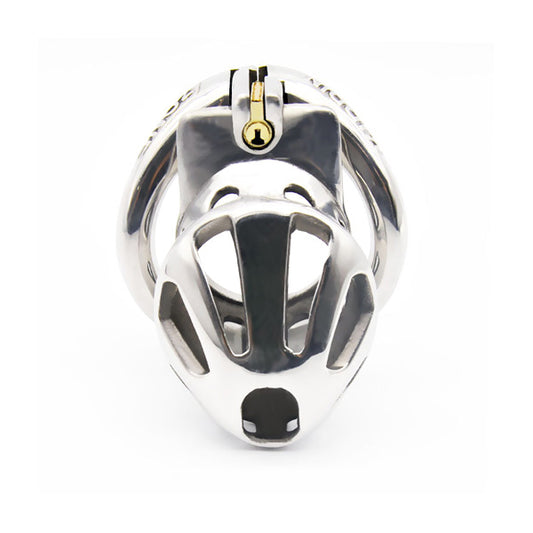
Chastity Cages Material Innovation (Resin vs. Metal)
Why 3D-Printed Resin Chastity Cages are the Future of Comfort vs. Traditional Metal Devices
Let's be honest for a second—if you're exploring the world of chastity devices, you've probably already discovered that comfort isn't just a luxury; it's the entire difference between a fulfilling experience and a frustrating one. And that's precisely why 3D-printed resin chastity cages are increasingly being recognized as the future of comfort when compared to traditional metal devices. The shift isn't just about materials—it's about a fundamental change in how these intimate products are designed, manufactured, and personalized.
For years, the chastity landscape was dominated by two main options: cheap plastic mass-produced cages and heavy-duty metal devices. But the emergence of additive manufacturing has completely rewritten the rules. Let's dive deep into why resin is changing the game, but also why it's essential to approach this new technology with the right knowledge and expectations.
Why Resin Chastity Cages are Better for Beginners than Metal
If you're new to chastity, the learning curve can feel steep. Between sizing challenges, understanding how your body responds, and figuring out what "comfortable" actually means, there's a lot to navigate. This is where resin cages truly shine.
The weight factor alone makes resin cages significantly more beginner-friendly. Imagine strapping a heavy metal device to your most sensitive areas and then trying to go about your day. Traditional metal cages can weigh anywhere from 150 to 300 grams or more, creating noticeable downward pull that causes scrotal fatigue and discomfort. In contrast, high-quality resin devices typically weigh just 40-80 grams—a fraction of the heft.
That lower mass reduces the gravitational drag that many beginners find exhausting. When you're still learning how your body interacts with a device, every gram matters. As The Kinky Tourist points out, resin devices are "substantially lighter than steel designs, reducing drag and scrotal fatigue during normal movement."
Temperature neutrality is another massive advantage for newcomers. Metal devices can feel shockingly cold when first put on (especially in cooler environments) or uncomfortably warm in hot weather. Resin, being a polymer, tends to acclimate to body temperature more quickly and feels less jarring against the skin. According to research from chastity communities, the initial temperature shock of metal can be off-putting for first-timers, while resin feels more "natural" from the moment of contact.
But perhaps the most important advantage is the forgiveness factor. Steel devices are rigid and unyielding. If your measurements are slightly off—and they often are for first-timers—the result can be pinching, chafing, or even circulation problems that escalate quickly. Resin cages, particularly those designed with contoured shapes, can be more accommodating of minor fit imperfections, giving beginners a safety margin that steel simply cannot provide.
However, and this is crucial: not all resin cages are created equal. The beginner-friendly approach isn't "buy the cheapest resin cage and hope for the best." Experts recommend a documented body-safe cage from an established manufacturer, starting with short initial wear sessions, and immediate removal for any pain, numbness, marked swelling, colour change, broken skin, or urinary difficulty. The material itself doesn't guarantee safety—the quality of manufacturing and finishing does.
Pros and Cons of Lightweight Plastic vs. Heavy Steel Chastity Cages
Let's break this down clearly because the decision between resin and metal isn't about "good" versus "bad"—it's about matching the right tool to the right needs. Here's a comprehensive comparison to help you understand the trade-offs.
| Factor | Resin / Nylon | Stainless Steel |
|---|---|---|
| Weight | Light to medium; reduced hanging force improves daily comfort | Heavy; some users prefer the solid feel but extended wear causes fatigue |
| Customization | Highly customizable via CAD; easy to adjust shape, length, openings, curves, and ring geometry | Limited; bespoke metalwork is possible but slower and expensive |
| Temperature | Closer to body temperature; less immediately noticeable | Can feel cold or hot depending on environment |
| Strength | Adequate only when properly engineered; brittle failure remains a concern | Very high strength and impact resistance |
| Hygiene | Depends on surface quality and certification; microscopic roughness can retain residue | Non-porous, corrosion-resistant, easy to sterilize |
| Allergy Risk | Low only with documented biocompatible resin and post-curing process | Low with quality 316L steel; those with metal sensitivities should verify alloy |
| Cost for Custom | More affordable for bespoke fits | Expensive for custom work |
| Discretion | Can be made in lower-profile, non-metallic forms | Visibly metallic; less discreet under clothing |
| Durability | Good for daily wear but vulnerable to impact and repeated stress | Excellent long-term durability |
| Cleaning | Requires careful finishing to ensure cleanability | Straightforward high-temperature cleaning and sterilization |
The weight conversation deserves more nuance. While some users genuinely appreciate the "feeling" of weight—a constant reminder of their device—for many, it becomes a source of daily irritation. Steel devices can cause scrotal tissue to stretch over time, leading to discomfort that builds throughout the day. Resin's lightweight nature means you can wear it longer without that nagging sensation.
When it comes to customization, the difference is stark. Traditional metal manufacturing requires expensive molds, casting tools, and skilled metalworkers to create non-standard shapes. Additive manufacturing, by contrast, allows designers to alter internal contours, ring geometry, ventilation openings, wall thickness, and cage length without creating new tooling. As demonstrated by Parametric cage projects and commercial custom products, this measurement-led approach is revolutionizing fit.
The aesthetics angle is worth mentioning too. Resin can be produced in skin tones, subtle colors, or virtually invisible low-profile designs that disappear under clothing. Steel is unmistakably, well, steel. For users who prioritize discretion in daily life, the visual advantage of resin is significant.
Are Resin Chastity Cages Skin-Safe? Understanding Biocompatibility
This is where things get serious—and where many manufacturers (and buyers) get it dangerously wrong.
The terms "skin-safe," "body-safe," and "biocompatible" are not interchangeable marketing buzzwords. A material might be inert after curing, but the actual finished device can still be unsuitable if it has uncured resin residue, a rough surface, sharp edges, trapped support material, or poor cleaning access. For genital contact—a remarkably sensitive area with thin, permeable skin—these details aren't minor issues; they're potential health risks.
A crucial distinction: Standard 3D printing resins, including many hobbyist UV-curable resins, are not inherently body-safe. They contain photoinitiators and monomers that can leach out if not properly cured, washed, and post-processed. A device that "looks fine" might still be leaching chemicals into your skin during extended wear.
For a truly body-safe resin device, a credible manufacturer should be able to:
- Identify the exact resin used
- Provide a safety data sheet or material documentation
- Explain their post-processing protocol in detail
- State whether the final material is certified for prolonged skin or mucosal contact
Consumer-grade hobby UV resins should not be assumed safe merely because they've been "cured." As experts emphasize, "resin is not automatically body-safe: long-term genital contact requires a verified biocompatible material, validated post-curing, smooth finishing, and conservative fit testing."
Your Biocompatibility Checklist
When evaluating a resin cage, go through this checklist:
- Named Material: Avoid listings that only say "resin," "UV resin," or "plastic." You need to know exactly what you're wearing.
- Documented Certification: Look for clear indication of biocompatibility or body-contact suitability. "Eco-friendly" claims don't count—you need medical-grade or ISO 10993-certified materials.
- Validated Post-Curing: Resin safety depends on washing and UV/thermal curing processes that fully address residual photoinitiators and uncured monomers. A manufacturer should explain this process.
- Smooth Finishing: The device should be polished, free of sharp seams, and have rounded edges at the ring, lock point, and ventilation openings. Run your finger along every surface—if you feel rough spots, they'll cause micro-abrasions.
- Neutral Smell: A strong chemical odour is a practical warning sign to stop and investigate material quality immediately.
- Patch Testing: Test gradually before extended wear, especially if you have sensitive skin or a history of contact dermatitis.
The safety conversation extends to metal as well. While 316L stainless steel is generally hypoallergenic, users with metal sensitivities should verify the specific alloy composition. Some cheaper metal devices contain nickel, which is a common allergen.

High-Airflow Designs: How 3D Printing Improves Chastity Hygiene
One of the most overlooked aspects of chastity wear is hygiene. Traditional metal cages, with their simple bar construction, actually do a reasonable job of allowing airflow and drainage. But 3D printing takes hygiene design to a completely new level.
What makes 3D-printed cages superior for hygiene? The ability to place openings exactly where they're needed. Designers can create longitudinal slots, open lattices, drainage channels, inspection windows, and wider access near areas that require washing and drying. Instead of a one-size-fits-all approach to ventilation, additive manufacturing enables function-driven geometry.
Open structures can improve airflow and permit fluids to drain rather than remaining trapped in an enclosed cage. This is particularly important for long-term wear, where trapped moisture can lead to skin irritation, fungal issues, or unpleasant odors.
The broader engineering principle is well-supported by scientific research: additive manufacturing can create ordered lattice structures with controllable porosity, open area, surface area, and airflow resistance. In a chastity device, that means geometry can be tuned for ventilation and cleaning access—but more openings aren't automatically safer if they create edges, snag points, or weak thin sections.
Design Features Worth Evaluating
When assessing a resin cage for hygiene and safety, look for:
- Long, rounded ventilation slots rather than narrow, sharp-edged perforations (which can pinch or abrade)
- Sufficient opening size for effective shower rinsing and thorough drying
- Drainage at the lowest point when standing and sitting—water should flow out, not pool
- Avoidance of ledges, seams, and blind internal corners that hold residue and bacteria
- Smooth transitions around the urethral opening and base-ring area to prevent irritation and injury
- Structural reinforcement around locks, hinge points, thin bridges, and high-stress corners—hygiene features shouldn't compromise integrity
Experts emphasize that these design considerations aren't cosmetic—they're functional necessities for safe, long-term wear.
How Durable are 3D-Printed Cages? Testing Chastity Cage Strength
Let's address the elephant in the room: a resin cage should not be marketed as indestructible. Compared with stainless steel, photopolymer resin is more vulnerable to cracking from impacts, repeated flexing, excessive force, poor layer orientation, insufficient wall thickness, or flaws around openings and seams.
This doesn't mean resin cages are fragile—properly engineered devices are perfectly adequate for normal daily wear. But they occupy a different category than steel in terms of strength expectations.
For a high-quality product, the relevant question isn't simply "What resin is used?" It's whether the entire device has been engineered and tested as a finished system. Every factor matters: material choice, print direction, cure method, wall thickness, reinforcement, surface preparation, lock interface, repeated-use performance, and realistic cleaning exposure.
Recommended Strength-Testing Framework
For a technically credible product, a manufacturer should test:
- Static Compression: Apply load to the cage body and ring to identify deformation or fracture thresholds.
- Lock-Interface Testing: Repeatedly load the locking tab, keyhole, hinge, or connector—these are the most likely failure points.
- Cycle Testing: Subject the device to repeated bending and normal handling simulation to assess fatigue cracking.
- Impact Testing: Conduct controlled drops onto hard surfaces to identify brittle-failure risks.
- Environmental Exposure: Re-test after repeated washing, sweat exposure, body-safe cleanser use, and UV ageing where relevant.
- Edge-Failure Assessment: Examine any failure mode for sharp fragments or exposed edges that could cause injury.
A useful product claim would be: "Designed for normal daily wear, not force, impact, or security-critical restraint." This is more defensible than comparing resin directly with steel on absolute strength.
The real-world experience shared by users confirms that resin cages can last for years with normal wear—provided they're treated with reasonable care. Dropping them on tile floors or using them as leverage during play, however, might end the experiment prematurely.
The Future of Technology: Custom Anatomical Scans for Chastity Cages
If you think 3D printing alone is revolutionary, wait until you see what happens when it combines with custom anatomical scanning. This is where the industry is heading, and it's genuinely exciting.
Traditional chastity sizing relies on self-measurement—which is notoriously inconsistent. Users measure base ring circumference, cage length, and gap width using flexible tape, but minor errors in measurement translate into major problems in fit. A few millimeters off can mean the difference between comfort and chafing.
Custom anatomical scanning changes everything. Instead of measuring, you create a digital model of your anatomy. This might involve:
- Photogrammetry (taking dozens of photos from different angles and converting them into a 3D model)
- Structured light scanning (using a specialized scanner to capture detailed surface geometry)
- Manual digital sculpting guided by comprehensive measurement protocols
Once you have an accurate digital model, the cage is designed around your specific shape rather than forcing your shape to fit a generic design.
The benefits are profound:
- Perfect base ring contour that matches your specific pelvic anatomy
- Optimal cage length that minimizes space while avoiding pressure
- Correct gap width that prevents testicle escape without restricting blood flow
- Contoured internal channels that accommodate your individual tissue shapes
- Ventilation placed where you need it rather than in generic positions
Some custom project designs already demonstrate this measurement-led approach, and commercial services are beginning to offer bespoke services using advanced scanning and CAD design. The technology is still emerging, but the potential is enormous.
This is the true game-changer: not resin versus metal, but anatomical customization versus one-size-fits-all manufacturing. Resin is the enabling technology, but the real revolution is putting the wearer's unique anatomy at the center of the design process.
Forma Comfyne and similar services are pioneering this approach, offering cages that are literally designed for you. The price point is higher than off-the-shelf devices, but for serious long-term wearers, the investment in comfort can be absolutely worth it.
Looking further ahead, we can imagine:
- Dynamic sizing guides that account for natural anatomical variations throughout the day
- Material density mapping that varies strength and flexibility based on functional needs
- Integrated health sensors (temperature, moisture, pressure) that provide real-time feedback
- AI-assisted design that optimizes geometry for both comfort and security simultaneously
The intersection of consumer 3D printing, anatomical scanning, and personal health technology is creating possibilities that were barely imaginable a decade ago.
Putting It All Together: Making the Right Choice
So where does this leave you? If you're considering a chastity device, here's my honest advice:
Choose resin if:
- You're a beginner looking for a forgiving introduction
- Comfort is your absolute priority (and let's be honest, it should be for most people)
- You want a custom fit without the enormous cost of bespoke metalwork
- Discretion under clothing matters to you
- You plan to wear your device for extended periods
Choose metal if:
- You need indestructible durability
- You want something that can be fully sterilized easily
- You genuinely prefer the feeling of weight
- You're engaging in activities that might expose the device to physical stress
- You're looking for a long-term investment that will outlast you
Choose custom scanning if:
- You've struggled with fit issues in the past
- You're committed to long-term wear and want the best possible experience
- You're willing to invest in premium comfort
- You appreciate cutting-edge technology and personalization
Final Thoughts: A Balanced Perspective
The chastity device market is evolving rapidly, and 3D-printed resin cages represent a genuine leap forward in comfort, customization, and accessibility. But they're not a universal replacement for metal—they're a new tool that excels in different scenarios.
The strongest editorial angle isn't "plastic replacing steel" but digital manufacturing enabling anatomically considered devices. Customization can reduce avoidable pressure points, improve clearance around sensitive tissue, and create more accessible cleaning paths—provided the final geometry remains structurally sound and safely sized.
Remember the most important rule of chastity wear: safety first, always. Whether you choose resin or metal, prioritize biocompatible materials, proper fit, gradual habituation, and immediate attention to any signs of discomfort or distress.
The future of chastity devices lies in personalization, not mass production. And that's a future worth embracing—thoughtfully, knowledgeably, and comfortably.
Cobra 6.1 Chastity Device - Nub
Sale price
$58.99 USD
Cobra 6.1 Chastity Device - Small
Sale price
$58.99 USD
Stainless Steel Chastity Cage S10 Tight
Sale price
$83.00 USD
Stainless Steel Chastity Cage S7 with Urethral Tube
Sale price
$59.99 USD